
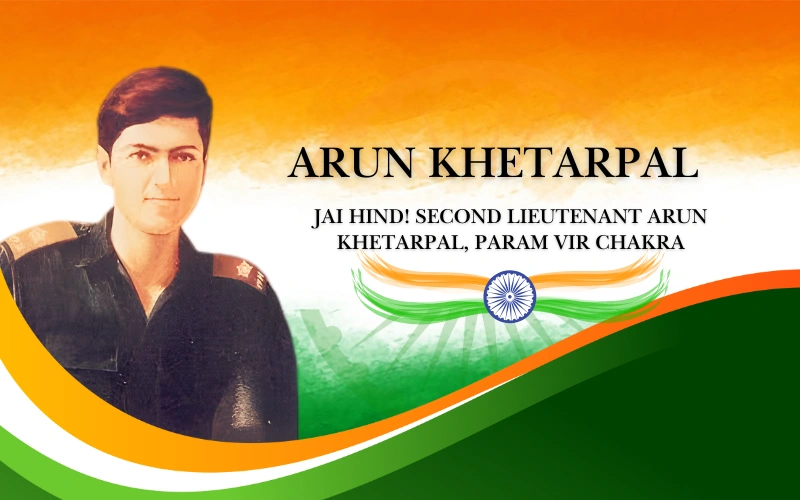
Arun Khetarpal was born on 14 October 1950 in Pune, Maharashtra, into a distinguished Punjabi Hindu Khatri family with deep military roots. At just 21 years of age, Second Lieutenant Arun Khetarpal made the supreme sacrifice during the Battle of Basantar in 1971, earning him India’s highest military decoration—the Param Vir Chakra. Arun Khetarpal is officially recognized as India’s “Tank Ace of Aces” with 10 confirmed tank kills, a record that stands as testimony to his exceptional combat skills and unwavering courage.
Quick Facts Summary Table
| Category | Details |
|---|---|
| Full Name | Second Lieutenant Arun Khetarpal, PVC |
| Date of Birth | 14 October 1950 |
| Place of Birth | Pune, Maharashtra, India |
| Date of Martyrdom | 16 December 1971 |
| Age at Martyrdom | 21 years |
| Nationality | Indian |
| Religion | Hindu (Punjabi Khatri) |
| Community | Khatri |
| Military Service | Indian Army – 17 Poona Horse |
| Tank Commanded | Centurion Tank “Famagusta” (JX 202) |
| Highest Award | Param Vir Chakra (Posthumous) |
| Battle | Battle of Basantar, 1971 Indo-Pak War |
| Tank Kills | 10 confirmed (India’s Tank Ace of Aces) |
| Zodiac Sign | Libra |
| Height | Approx. 5’10” (178 cm) |
| Marital Status | Unmarried |
Personal Information: The Hero’s Profile
Arun Khetarpal was born on 14 October 1950 in Pune, Maharashtra, into a distinguished Punjabi Hindu Khatri family with deep military roots. At just 21 years of age, Second Lieutenant Arun Khetarpal made the supreme sacrifice during the Battle of Basantar in 1971, earning him India’s highest military decoration—the Param Vir Chakra. Arun Khetarpal is officially recognized as India’s “Tank Ace of Aces” with 10 confirmed tank kills, a record that stands as testimony to his exceptional combat skills and unwavering courage.
Detailed Personal Information Table
| Attribute | Information |
|---|---|
| Full Name | Arun Khetarpal |
| Rank | Second Lieutenant (2/Lt) |
| Service Number | IC-25067 |
| Date of Birth | 14 October 1950 |
| Birth Place | Pune, Maharashtra, India |
| Ancestral Origin | Sargodha, West Punjab (now Pakistan) |
| Zodiac Sign | Libra |
| Nationality | Indian |
| Religion | Hinduism |
| Caste/Community | Punjabi Khatri |
| Languages Known | Hindi, English, Punjabi |
| Marital Status | Unmarried |
| Date of Martyrdom | 16 December 1971 |
| Place of Martyrdom | Jarpal, Shakargarh Sector (Battle of Basantar) |
| Age at Death | 21 years, 2 months, 2 days |
| Cremation Date | 17 December 1971 |
| Cremation Place | Near Samba District, Jammu |
Family & Personal Life: A Legacy of Military Service
The Khetarpal family represents generations of military service and patriotic dedication. Arun Khetarpal’s upbringing in a disciplined military environment shaped his character and prepared him for the ultimate test of courage.
Family Background Table
| Relation | Name | Details |
|---|---|---|
| Father | Lt Col M.L. Khetarpal (later Brigadier) | Served in Indian Army Corps of Engineers |
| Mother | Mrs. Khetarpal | Homemaker, pillar of family strength |
| Brother | Mukesh Khetarpal | Elder brother, also served in Indian Army |
| Grandfather | Not Named | Fought in World War I |
| Great-Grandfather | Not Named | Served in Sikh Khalsa Army |
| Spouse | Unmarried | Martyred at age 21 before marriage |
| Children | None | Gave his life for the nation |
| Hometown | Pune, Maharashtra | Place of birth and upbringing |
| Ancestral Home | Sargodha, Punjab (now Pakistan) | Pre-partition family origin |
The Khetarpal Military Lineage
Arun Khetarpal was born into a family where military service was not just a profession but a sacred duty passed down through generations:
Great-Grandfather’s Era: Served in the Sikh Khalsa Army, representing the martial tradition of Punjab.
Grandfather’s Service: Fought bravely in World War I, experiencing the global conflict that shaped the 20th century.
Father – Lt Col (later Brigadier) M.L. Khetarpal: A distinguished officer in the Indian Army Corps of Engineers, Arun Khetarpal’s father provided both inspiration and guidance. He instilled values of duty, honor, and sacrifice in his sons. After Arun Khetarpal’s martyrdom, Brigadier Khetarpal showed remarkable grace and dignity, even befriending the Pakistani officer who fought against his son.
Elder Brother – Mukesh Khetarpal: Continued the family tradition by serving in the Indian Army, ensuring the Khetarpal legacy lived on.
Family Values and Upbringing
The Khetarpal household was one where:
- Discipline and punctuality were paramount
- National service was considered the highest calling
- Stories of military valor were dinner table conversations
- Character and integrity were valued above all else
- Education and physical fitness received equal importance
Arun Khetarpal grew up in various military cantonments as his father was posted to different locations. This exposure to military life from childhood prepared him naturally for a career in the armed forces.
Physical Statistics: The Warrior’s Build
| Attribute | Measurement |
|---|---|
| Height | Approximately 5’10” (178 cm) |
| Weight | Approximately 70 kg (154 lbs) |
| Build | Athletic and fit |
| Eye Color | Dark Brown |
| Hair Color | Black |
| Physical Fitness | Excellent – required for Armoured Corps |
| Distinguishing Features | Confident military bearing, strong physique |
| Endurance Level | Superior – trained for tank warfare |
Arun Khetarpal maintained exceptional physical fitness throughout his training at NDA and IMA. Tank commanders require not just strength but stamina, as operating a Centurion tank in combat conditions demands hours of concentration in cramped, hot conditions while maintaining alertness for enemy threats.
Educational Background: Journey to Excellence
Arun Khetarpal’s educational journey was marked by consistent excellence, leadership qualities, and a clear focus on military service from an early age.
Complete Academic Journey Table
| Institution | Location | Period | Key Achievements |
|---|---|---|---|
| St. Columba’s School | Delhi | Early education | Foundation years, character development |
| Lawrence School | Sanawar, Himachal Pradesh | Secondary education | School Prefect, excelled in academics & sports |
| National Defence Academy | Khadakwasla, Pune | June 1967 – Dec 1970 | 38th Course, Foxtrot Squadron |
| Squadron Position | NDA | During training | Squadron Cadet Captain, led Foxtrot to championship |
| Indian Military Academy | Dehradun, Uttarakhand | 1970 – June 1971 | Carried President’s colours in final term |
| Commissioning | IMA | 13 June 1971 | Commissioned as Second Lieutenant |
| Specialized Training | Ahmednagar | Post-commissioning | Centurion tank warfare training |
St. Columba’s School, Delhi
Arun Khetarpal began his formal education at St. Columba’s School in Delhi, one of India’s premier educational institutions. Here, he developed:
- Strong academic foundation
- Early leadership qualities
- Love for sports and outdoor activities
- Discipline and time management skills
The Lawrence School, Sanawar: Building Character
The Lawrence School, Sanawar, established in 1847, is one of Asia’s oldest boarding schools. Arun Khetarpal joined this prestigious institution where he truly blossomed:
Academic Excellence: Distinguished himself as an able student across all subjects, particularly excelling in history, mathematics, and general studies.
Sports Achievement: Actively participated in athletics, team sports, and adventure activities. The school’s emphasis on physical education prepared him perfectly for military life.
Leadership Role: Appointed as School Prefect, a position of high responsibility where Arun Khetarpal demonstrated his natural leadership abilities and ability to inspire peers.
Character Formation: The school’s motto “Never Give In” became deeply embedded in Arun Khetarpal’s character—words that would prophetically define his final stand at Basantar.
National Defence Academy: The Foundation (1967-1970)
In June 1967, Arun Khetarpal joined the National Defence Academy as part of the 38th Course, assigned to Foxtrot Squadron. His NDA number was 7498/F/38, a number that would become legendary in military circles.
Outstanding Achievement at NDA:
Squadron Cadet Captain: Arun Khetarpal was appointed as the Squadron Cadet Captain of Foxtrot Squadron—a position given only to the most outstanding cadets. Under his leadership and watch, Foxtrot Squadron became the champions, showcasing his exceptional leadership and team-building abilities.
Training Components:
- Academic Education: Bachelor’s degree program with focus on military history, strategy, international relations
- Military Training: Infantry tactics, weapon handling, field craft, navigation
- Physical Conditioning: Rigorous PT, cross-country runs, obstacle courses, swimming
- Leadership Development: Command tasks, group activities, responsibility positions
- Character Building: Ethics, values, military traditions, gentleman conduct
Arun Khetarpal excelled in all aspects of NDA training, proving himself not just as a good cadet but as an exceptional future officer.
Indian Military Academy: Final Polish (1970-1971)
After successfully completing three years at NDA, Arun Khetarpal proceeded to the Indian Military Academy in Dehradun for pre-commissioning training.
Special Honor: In his final term at IMA, Arun Khetarpal was given the rare privilege of carrying the President’s colours—an honor bestowed only upon the most outstanding Gentleman Cadets. This recognition demonstrated that even among the best, Arun Khetarpal stood out.
IMA Training Focus:
- Advanced tactics and strategy
- Armoured corps specialization
- Leadership in combat scenarios
- Command and control systems
- Military law and administration
- Intensive field exercises
Commissioning Day – 13 June 1971: On this proud day, Arun Khetarpal was commissioned as a Second Lieutenant in the Indian Army, joining the prestigious 17 Poona Horse, one of India’s most decorated armoured regiments.
Post-Commissioning Training
After commissioning, Arun Khetarpal underwent specialized training:
- Armoured Corps Training: At the Armoured Corps Centre and School, Ahmednagar
- Centurion Tank Operations: Mastering the British-made Centurion tank
- Tank Gunnery: Precision shooting and tactical engagement
- Crew Coordination: Leading and synchronizing tank crew operations
- Armoured Warfare Tactics: Movement, positioning, and battlefield strategy
This training would prove crucial during the Battle of Basantar, where Arun Khetarpal’s exceptional gunnery and tactical skills enabled him to destroy 10 enemy tanks.
Military Career Timeline: Six Months of Immortality
Though Arun Khetarpal’s active service lasted only six months, his impact was extraordinary and everlasting.
Complete Career Timeline Table
| Date | Event | Details |
|---|---|---|
| June 1967 | Joined NDA | 38th Course, Foxtrot Squadron, NDA No. 7498/F/38 |
| 1967-1970 | NDA Training | Squadron Cadet Captain, led Foxtrot to championship |
| December 1970 | Graduated NDA | Completed three years of training |
| 1970-1971 | IMA Training | Carried President’s colours in final term |
| 13 June 1971 | Commissioned | Second Lieutenant, 17 Poona Horse |
| June-Nov 1971 | Peace-time Training | Centurion tank operations, crew leadership |
| 3 December 1971 | War Begins | 17 Poona Horse deployed to Shakargarh sector |
| 15 December 1971 | Pre-Battle Operations | Regiment crossed minefield to support infantry |
| 16 December 1971, 08:00 | Battle Begins | Pakistani 13 Lancers attack at Jarpal |
| 16 December 1971, Morning | First Engagement | Arun Khetarpal destroys multiple enemy tanks |
| 16 December 1971, Afternoon | Supreme Sacrifice | Refuses to abandon tank, destroys 10th tank, martyred |
| 17 December 1971 | Cremation | Near Samba District with military honors |
| 26 December 1971 | Family Informed | Parents learn of martyrdom (10 days later) |
| 26 January 1972 | Param Vir Chakra | Posthumous award on Republic Day |
The Battle of Basantar: India’s Greatest Tank Battle
The Battle of Basantar, fought on 16 December 1971, stands as one of the largest and most decisive tank battles since World War II. Arun Khetarpal’s role in this battle earned him immortality.
Battle Context and Strategic Importance
Location: Shakargarh Sector, near the village of Jarpal (also called Bara Pind by Pakistanis)
Date: 15-16 December 1971
Indian Forces: 17 Poona Horse (Centurion tanks) supporting 47th Infantry Brigade
Pakistani Forces: 13 Lancers Regiment (American-supplied Patton tanks)
Objective:
- Indian: Establish bridgehead across Basantar River, prevent Pakistani breakthrough
- Pakistani: Counter-attack to break Indian advance and regain lost territory
The Night Before (15 December 1971)
By 21:00 hours on 15 December, the 47th Infantry Brigade had captured its objectives and established positions across the Basantar River. However, the area was heavily mined, preventing deployment of the 17 Poona Horse tanks.
Critical Decision: When enemy armour activity was reported, the regiment made the bold decision to push through the minefield under cover of darkness—an extremely dangerous maneuver that demonstrated the urgency of the situation.
Arun Khetarpal and his troop successfully navigated the minefield and linked up with infantry by first light on 16 December, positioning themselves for the coming battle.
16 December 1971: The Day of Destiny
08:00 Hours – The First Attack:
Pakistani 13 Lancers, equipped with powerful American-made Patton tanks, launched their first counter-attack under cover of a smokescreen. The attack was directed at ‘B’ Squadron of 17 Poona Horse at Jarpal.
Arun Khetarpal’s immediate response showcased his training and instinct. Though assigned to ‘A’ Squadron, he was positioned nearby. Hearing the urgent call for reinforcements, Arun Khetarpal responded with alacrity, leading his troop toward the battle.
En Route Combat: While moving to support B Squadron, Arun Khetarpal encountered enemy strongpoints and RCL (Recoilless Gun) nests still holding out. With time being critical, he made a bold tactical decision—literally charging the enemy positions with his tanks, overrunning defense works, and capturing enemy infantry and weapon crews at pistol point.
First Tank Kill: During this advance, the commander of Arun Khetarpal’s second tank was killed in action. Despite this loss, Arun Khetarpal pressed forward and arrived just in time to engage Pakistani tanks attempting to break through.
His accurate gunnery destroyed the first enemy tank, and his aggressive action forced the Pakistani tanks to pull back. The first counter-attack was decimated by the cool, accurate shooting and leadership of Indian tank commanders, from Commanding Officer Lt Col Hanut Singh down to troop leader Arun Khetarpal.
Mid-Day – Second and Third Attacks:
The Pakistani 13 Lancers, desperate to achieve breakthrough, launched two more squadron-level counter-attacks. These attacks were larger and more determined.
Arun Khetarpal’s tactical acumen came to the fore. He positioned his remaining two tanks advantageously, using terrain and tactical knowledge to maximize firing effectiveness while minimizing exposure.
Afternoon – The Critical Battle:
The Pakistani forces regrouped and launched their most determined assault, selecting Arun Khetarpal’s sector as the point of their main effort. What followed was one of the fiercest tank battles in military history.
The Supreme Sacrifice
The Tank Duel:
Arun Khetarpal, with just his two tanks, faced a squadron of Pakistani Patton tanks advancing toward him. The odds were overwhelming, but retreat was not in his vocabulary.
Tank after tank fell to Arun Khetarpal’s devastating accurate fire. His gunner, Sowar Nathu Singh, and he worked in perfect synchronization, acquiring targets, firing, and immediately seeking the next threat.
First Hit: Arun Khetarpal’s tank “Famagusta” was hit by enemy fire. The impact killed his radio operator, Sowar Nand Singh, instantly. The tank was damaged and Arun Khetarpal was wounded by shrapnel.
The Immortal Decision:
His squadron commander, monitoring the battle, saw Arun Khetarpal’s tank was hit and ordered: “Arun, your tank is hit, you are wounded, abandon your tank and move out.”
Over the radio came the response that would echo through history:
“No Sir, I will not abandon my tank. My gun is still working and I will get these bastards.”
In that moment, Second Lieutenant Arun Khetarpal, just 21 years old, consciously chose duty over life, mission over safety.
The Final Stand:
Despite his wounds, despite his damaged tank, despite the overwhelming odds, Arun Khetarpal continued fighting. His immobilized tank became a stationary fortress from which he dealt death to the enemy.
Ninth Tank Destroyed: Arun Khetarpal destroyed another Pakistani tank.
Tenth Tank Destroyed: With enemy tanks closing in, Arun Khetarpal lined up his final shot. The last enemy tank he destroyed was barely 100 meters from his position—point-blank range in tank warfare.
The Second Hit:
As Arun Khetarpal engaged the tenth tank, another enemy tank fired at his exposed position. The shell struck the turret of “Famagusta” directly. Second Lieutenant Arun Khetarpal was killed instantly.
His gunner, Sowar Nathu Singh, and driver, Sowar Prayag Singh, were both severely wounded but survived, later being captured by Pakistani forces.
Battle Outcome
Arun Khetarpal’s sacrifice was not in vain:
Pakistani Attack Failed: The enemy breakthrough was denied. Not one Pakistani tank got through the 17 Poona Horse positions.
Decisive Victory: The Battle of Basantar ended in overwhelming Indian victory. The Pakistani armoured thrust was not just stopped but destroyed.
Strategic Impact: This victory contributed significantly to India’s decisive win in the 1971 war, leading to the liberation of Bangladesh.
Arun Khetarpal’s Personal Tally:
- 10 confirmed tank kills – making him India’s “Tank Ace of Aces”
- Multiple enemy strongpoints overrun
- Hundreds of enemy soldiers killed or captured
- Breakthrough denied at the most critical point
Tank Crew – The Team Behind the Hero
Arun Khetarpal’s Centurion tank “Famagusta” (JX 202) crew consisted of:
| Position | Name | Fate |
|---|---|---|
| Tank Commander | 2nd Lt Arun Khetarpal | Killed in Action (KIA) |
| Radio Operator | Sowar Nand Singh | Killed in Action (first hit) |
| Gunner | Sowar Nathu Singh | Wounded, captured by Pakistan |
| Driver | Sowar Prayag Singh | Wounded, captured by Pakistan |
After the war, Pakistan returned captured personnel. The tank “Famagusta” was also eventually returned and is now displayed at the Armoured Corps Centre and School in Ahmednagar as a testament to Arun Khetarpal’s valor.
Param Vir Chakra: India’s Highest Honor
On 26 January 1972, Republic Day, Arun Khetarpal was posthumously awarded the Param Vir Chakra, India’s highest military decoration for valor in the face of the enemy.
Award Details Table
| Aspect | Details |
|---|---|
| Award | Param Vir Chakra (PVC) |
| Type | Posthumous |
| Announcement Date | 26 January 1972 (Republic Day) |
| Presented To | Brigadier M.L. Khetarpal (father) |
| Presented By | President V.V. Giri |
| Citation For | Battle of Basantar, 16 December 1971 |
| Service Number | IC-25067 |
| Rank | Second Lieutenant |
| Unit | 17 Poona Horse |
| Official Gazette | 2 September 1972 |
Major Achievements & Recognition
Comprehensive Awards & Honors Table
| Year | Award/Recognition | Details |
|---|---|---|
| 1971 | 10 Confirmed Tank Kills | India’s “Tank Ace of Aces” |
| 1972 | Param Vir Chakra | India’s highest military decoration (posthumous) |
| 1972 | Republic Day Honor | Father received PVC from President V.V. Giri |
| 1988 | DD National TV Series | Featured in Param Vir Chakra TV series (Episode 14) |
| 2001 | Enemy Commander Tribute | Brigadier Naser’s emotional meeting with father |
| 2009 | Balidan Stambh Memorial | Name inscribed at Jammu war memorial |
| 2015 | Amar Chitra Katha Graphic Novel | Story published for young readers |
| 2017 | Malayalam Film | Character inspired by him in “1971: Beyond Borders” |
| 2019 | Roli Books Graphic Novel | Dedicated biography by Ian Cardozo |
| 2021 | 50th Anniversary Tributes | Nationwide commemorations |
| Ongoing | NDA Khetarpal Ground | Parade ground named in his honor |
| Ongoing | IMA Auditorium | Named after him |
| Ongoing | IMA Gate | Main gate bears his name |
| Ongoing | Tank Display | “Famagusta” displayed at Ahmednagar |
| Upcoming | Bollywood Film “Ikkis” | Biopic starring Agastya Nanda, directed by Sriram Raghavan |
SECOND LIEUTENANT ARUN KHETARPAL, POONA HORSE (IC-25067)
On 16 December 1971, the Squadron Commander of ‘B’ Squadron, the Poona Horse asked for reinforcement as the Pakistani Armour which was superior in strength, counter attacked at Jarpal, in the Shakargarh Sector. On hearing this transmission, Second Lieutenant Arun Khetarpal who was in ‘A’ Squadron, voluntarily moved along with his troops, to assist the other squadron.
En route, while crossing the Basantar river, Second Lieutenant Arun Khetarpal and his troops came under fire from enemy strong points and RCL gun nests that were still holding out. Time was at a premium and as critical situation was developing in the ‘B’ Squadron sector, Lieutenant Arun Khetarpal, threw caution to the winds and started attacking the impending enemy strong points by literally charging them, overrunning the defence works with his tanks and capturing the enemy infantry and weapon crew at pistol point.
In this action the commander of his troop was killed. Second Lieutenant Arun Khetarpal continued to attack relentlessly until all enemy opposition was overcome and he broke through towards the ‘B’ Squadron position, just in time to see the enemy tanks pulling back after their initial probing attack on this squadron.
He was so carried away by the wild enthusiasm of battle and the impetus of his own headlong dash that he started chasing the withdrawing tanks and even managed to shoot and destroy one. Soon thereafter, the enemy reformed with a squadron of armour for a second attack and this time they selected the sector held by Second Lieutenant Arun Khetarpal and two other tanks as the points for their main effort.
A fierce tank fight ensured ten enemy tanks were hit and destroyed of which Second Lieutenant Arun Khetarpal accounted for four himself. In this tank battle, Second Lieutenant Arun Khetarpal was severely wounded. He was asked to abandon his tank but he realised that the enemy though badly decimated was continuing to advance in his sector of responsibility and if he abandoned his tank the enemy would break through, he gallantly fought on and destroyed another enemy tank.
At this stage, his tank received a second hit which resulted in the death of this gallant officer.
Second Lieutenant Arun Khetarpal was dead but he had, by his intrepid valour saved the day; the enemy was denied the breakthrough he was so desperately seeking. Not one enemy tank got through.
Second Lieutenant Arun Khetarpal had shown the best qualities of leadership, tenacity of purpose and the will to close in with the enemy. This was an act of courage and self-sacrifice far beyond the call of duty.
What the Param Vir Chakra Represents
The Param Vir Chakra is awarded for:
- “Most conspicuous bravery or some daring or pre-eminent act of valor or self-sacrifice”
- “In the presence of the enemy, whether on land, at sea, or in the air”
Arun Khetarpal fully embodied these criteria:
- Conspicuous Bravery: His refusal to abandon his tank despite wounds
- Daring Act: Charging enemy positions and pursuing withdrawing tanks
- Valor: Destroying 10 enemy tanks in fierce combat
- Self-Sacrifice: Choosing death over abandoning his responsibility
As of 2025, only 21 individuals have been awarded the Param Vir Chakra, making Arun Khetarpal part of India’s most elite group of war heroes.
Detailed Biography: The Complete Story
Early Life: A Soldier in the Making (1950-1967)
Arun Khetarpal was born on 14 October 1950 in Pune, Maharashtra, into a family where military service was a tradition and honor. His father, M.L. Khetarpal, was serving as an officer in the Indian Army, and young Arun grew up in the disciplined environment of military cantonments.
From childhood, Arun Khetarpal displayed the qualities that would later define his military career: courage, leadership, and an unwavering sense of duty. He was an active, energetic boy who loved outdoor activities and sports. Growing up in the 1950s and 1960s, he witnessed India’s growth as a young nation and the Indian Army’s evolution into a professional force.
His parents ensured that he received the best education possible while instilling strong values of integrity, honor, and national service. The Khetarpal household was one where dinner table conversations often revolved around military history, strategy, and the responsibilities of those who serve in uniform.
Education at Lawrence School, Sanawar
Arun Khetarpal’s formal education began at Lawrence School, Sanawar, one of India’s most prestigious boarding schools. Established in 1847, this institution had a long tradition of producing leaders for the Indian armed forces.
At Sanawar, Arun Khetarpal thrived in the structured environment. He excelled in:
- Academic subjects, particularly history and mathematics
- Sports, especially athletics and team games
- Leadership roles in student activities
- Character development through the school’s value system
The school’s motto, “Never Give In,” became deeply embedded in Arun Khetarpal’s character. His teachers remember him as a determined student who approached every challenge with enthusiasm and tenacity.
National Defence Academy: The Foundation (1967-1970)
In 1967, at the age of 17, Arun Khetarpal joined the National Defence Academy as part of the 61st Course. The NDA, located in Khadakwasla near Pune, is where India’s future military leaders undergo rigorous training for three years before being commissioned into the Army, Navy, or Air Force.
At NDA, Arun Khetarpal underwent comprehensive training that included:
Academic Education:
- Bachelor of Arts degree program
- Military history and strategic studies
- Leadership and management principles
- International relations and geopolitics
Military Training:
- Infantry tactics and field craft
- Weapon training and handling
- Physical conditioning and endurance
- Drill and ceremonial procedures
Character Development:
- Leadership exercises and command tasks
- Team building and cooperation
- Ethics and military values
- Stress management under pressure
Arun Khetarpal distinguished himself as a cadet who embodied the NDA’s ideals of “Service Before Self.” His peers remember him as someone who led by example, never asked others to do what he wouldn’t do himself, and maintained high standards in all activities.
Indian Military Academy: The Final Polish (1970-1971)
After successfully completing three years at NDA, Arun Khetarpal moved to the Indian Military Academy in Dehradun for the final stage of pre-commissioning training. The IMA focuses on converting cadets into commissioned officers ready for operational service.
During his time at IMA, Arun Khetarpal:
- Specialized in armoured corps operations
- Mastered advanced tactical concepts
- Developed command and leadership skills specific to leading troops in combat
- Underwent intensive physical and mental conditioning
On 13 June 1971, Arun Khetarpal was commissioned as a Second Lieutenant in the Indian Army. His choice of regiment was the prestigious 17 Poona Horse, an armoured regiment with a history dating back to the early 19th century.
Six Months of Service: June-December 1971
Arun Khetarpal’s active military career, though tragically brief, was marked by rapid learning and preparation for combat.
June-November 1971: Training and Preparation After commissioning, Second Lieutenant Arun Khetarpal joined his regiment and underwent:
- Specialized training on the Centurion tank
- Integration with B Squadron, 17 Poona Horse
- Tactical exercises and war games
- Bonding with his troop and squadron
His commanding officers quickly recognized his potential. Despite being fresh out of military academy, Arun Khetarpal displayed maturity beyond his years and a natural aptitude for armoured warfare.
December 1971: The Test of Fire
On December 3, 1971, Pakistan launched pre-emptive air strikes on Indian air fields, marking the beginning of the Indo-Pakistan War of 1971. The 17 Poona Horse was deployed to the Shakargarh sector in the western front, one of the critical battlegrounds of the war.
Arun Khetarpal, commanding a troop of three Centurion tanks, was about to face the ultimate test of his training and character.
The Battle of Basantar: 16 December 1971
The Battle of Basantar, fought on December 16, 1971, would become one of the most significant tank battles in military history and the defining moment of Arun Khetarpal’s life.
The Strategic Situation: The Pakistani forces were attempting a major armoured thrust to break through Indian defenses in the Shakargarh sector. The objective was to cut off Indian forces and potentially threaten key positions. The Indian Army’s task was to not only stop this thrust but to inflict maximum damage on the enemy armoured formations.
B Squadron’s Role: B Squadron of 17 Poona Horse was positioned to counter any Pakistani armoured advance. Arun Khetarpal, as a troop commander, was responsible for three Centurion tanks and their crews.
The Battle Unfolds:
Morning, December 16: As dawn broke, Pakistani Patton tanks began their advance toward Indian positions. Second Lieutenant Arun Khetarpal, alert in his tank, spotted the enemy movement first. Without hesitation, he engaged the lead Pakistani tank, destroying it with accurate fire. His quick action alerted the entire squadron to the threat.
The Main Engagement: As more Pakistani tanks advanced, a fierce battle ensued. Arun Khetarpal maneuvered his tank skillfully, using terrain to advantage while maintaining aggressive fire on enemy positions. His crew—gunner, loader, and driver—worked with precision, reflecting their commander’s training and leadership.
Tank after tank fell to Arun Khetarpal’s accurate gunnery. The Centurion tanks, though fewer in number, were proving superior to the American-supplied Pakistani Pattons, especially with officers like Arun Khetarpal commanding them.
The Critical Moment: During the intense firefight, Arun Khetarpal’s tank took a hit. The shell damaged the tank’s mobility, making it a static target. Standard military doctrine in such situations is clear: a disabled tank is extremely vulnerable, and the crew should abandon it to fight another day.
Arun Khetarpal was wounded by shrapnel from the hit. His commanding officer, Major Daljit Singh Narang, seeing the danger, radioed him: “Arun, your tank is hit, you are wounded, abandon your tank and move out.”
The Immortal Response: What came back over the radio would echo through Indian military history:
“No Sir, I will not abandon my tank. My gun is still working and I will get these bastards.”
In that moment, Second Lieutenant Arun Khetarpal, at age 21, with only six months of service, made the decision that would define his legacy and inspire generations.
The Final Stand: Arun Khetarpal continued engaging enemy tanks from his immobilized position. His exposed tank drew concentrated enemy fire, but he refused to stop fighting. His gun continued to roar, destroying more Pakistani tanks.
Finally, a direct hit from a Pakistani tank struck Arun Khetarpal’s turret. The young officer was killed instantly, but not before he had destroyed multiple enemy tanks and broken the momentum of the Pakistani attack.
The Aftermath: Inspired by Arun Khetarpal’s sacrifice and example, B Squadron and the entire regiment fought with renewed determination. The Battle of Basantar ended in a decisive Indian victory. The Pakistani armoured thrust was not only stopped but destroyed. India went on to win the war decisively, leading to the liberation of Bangladesh.
Recognition and Honor
Param Vir Chakra: On 26 January 1972, Republic Day, Arun Khetarpal was posthumously awarded the Param Vir Chakra, India’s highest military decoration for valor. His father, Lieutenant General M.L. Khetarpal, received the award from President V.V. Giri in a ceremony that moved the entire nation.
Impact on 17 Poona Horse: The regiment’s battle honors include the Battle of Basantar, and Arun Khetarpal remains the regiment’s most celebrated hero. His photograph adorns the officers’ mess, and his story is told to every new officer who joins the regiment.
Final Tribute
In the pantheon of Indian military heroes, Second Lieutenant Arun Khetarpal, Param Vir Chakra, occupies a special place. His youth, his brief service, his extraordinary valor, and his supreme sacrifice embody everything that is noble about military service.
Arun Khetarpal didn’t just fight a battle; he demonstrated what it means to be a warrior. He didn’t just follow orders; he exemplified leadership. He didn’t just die in combat; he chose honor over life in a conscious, deliberate act of supreme courage.
More than five decades after that December day in 1971, Arun Khetarpal remains alive—in the hearts of his regiment, in the curriculum of military academies, in the inspiration he provides to young Indians, and in the eternal gratitude of a nation he died defending.
His tank may have fallen silent on December 16, 1971, but his voice—saying “No Sir, I will not abandon my tank”—echoes still, calling every generation to duty, honor, and sacrifice.
Jai Hind! Second Lieutenant Arun Khetarpal, Param Vir Chakra—Present!
A grateful nation salutes its immortal warrior.
Frequently Asked Questions (FAQ)
1. What was Arun Khetarpal’s current position?
Second Lieutenant Arun Khetarpal was serving as a Troop Commander in B Squadron, 17 Poona Horse, when he was martyred on December 16, 1971.
2. Was Arun Khetarpal married?
No, Arun Khetarpal was unmarried at the time of his martyrdom. He was only 21 years old.
3. What was Arun Khetarpal’s UPSC rank or educational qualification?
Arun Khetarpal was not a civil servant. He was a military officer who graduated from the National Defence Academy (61st Course) and the Indian Military Academy. He did not appear for UPSC civil services examinations.
4. What is the Param Vir Chakra?
The Param Vir Chakra is India’s highest military decoration, awarded for the most conspicuous bravery or some daring or pre-eminent act of valor or self-sacrifice in the presence of the enemy. Arun Khetarpal received this honor posthumously in 1972.
5. How long was Arun Khetarpal’s military service?
Arun Khetarpal served for only six months, from his commissioning on June 13, 1971, to his martyrdom on December 16, 1971.
6. What was the Battle of Basantar?
The Battle of Basantar was a major tank battle fought on December 16, 1971, during the Indo-Pakistan War. It took place in the Shakargarh sector and resulted in a decisive Indian victory. Arun Khetarpal played a crucial role in this battle.
7. How many enemy tanks did Arun Khetarpal destroy?
While exact numbers vary in different accounts, Arun Khetarpal destroyed multiple Pakistani Patton tanks during the Battle of Basantar, significantly contributing to the Indian victory.
Read More: Anjana Krishna IPS
Explore more blogs at: A Brand Owner
Nishant Kumar is the founder and lead content creator at OfficersDetails.com, a platform dedicated to delivering accurate, verified information about officers in government, corporate, and legal sectors. With a strong background in public administration and data research, Nishant is passionate about transparency, governance, and simplifying access to essential leadership profiles.