
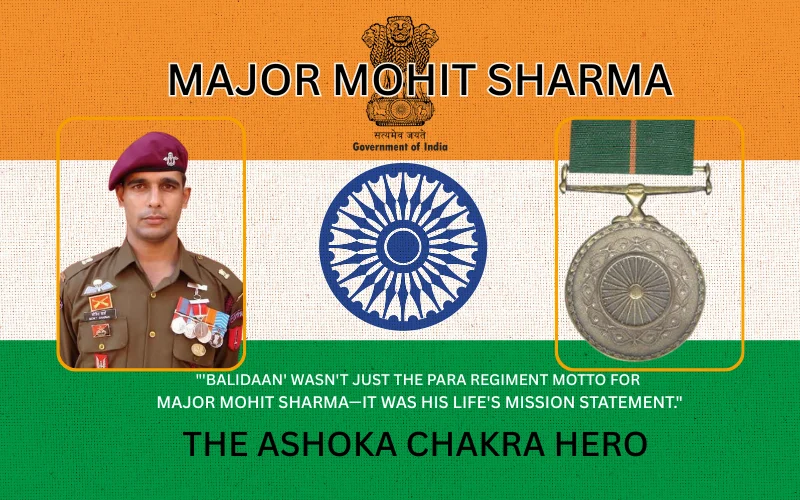
Major Mohit Sharma: The Para SF Hero Who Chose Country Over Comfort and Immortality Over Life
Personal Information
| Attribute | Details |
|---|---|
| Full Name | Major Mohit Sharma |
| Nickname | “Chintu” (family), “Mike” (NDA batch mates) |
| Date of Birth | 13 January 1978 |
| Birth Place | Rohtak, Haryana, India |
| Date of Martyrdom | 21 March 2009 |
| Age at Martyrdom | 31 years |
| Nationality | Indian |
| Zodiac Sign | Capricorn |
| Religion | Hindu |
| Ancestral Village | Rasna, Meerut District, Uttar Pradesh |
| Military Rank | Major |
| Service Branch | Indian Army – 1st Para (Special Forces) |
| Service Number | IC-56899 |
Family & Personal Life
| Relationship | Name |
|---|---|
| Father | Rajendra Prasad Sharma |
| Mother | Sushila Sharma |
| Birth Order | Second-born of the Sharma family |
| Hometown | Village Rasna, District Meerut, Uttar Pradesh |
| Marital Status | Married |
| Family Type | Hindu family with strong patriotic values |
Major Mohit Sharma came from a humble family background with deep roots in Uttar Pradesh. His parents instilled in him values of courage, dedication, and service to the nation. As the second-born child, Major Mohit Sharma displayed exceptional leadership qualities from a young age, earning him the affectionate nickname “Chintu” within his family.
Educational Background & Academic Journey
Schooling
| Level | Institution | Year | Location |
|---|---|---|---|
| 12th Standard | Delhi Public School | 1995 | Ghaziabad, Uttar Pradesh |
| Engineering (Brief) | Shri Sant Gajanan Maharaj College of Engineering | 1995 | Shegaon, Maharashtra |
Military Education
| Institution | Period | Achievement |
|---|---|---|
| National Defence Academy (NDA) | December 1995 – 1998 | Joined 81st Course, Expert in swimming, boxing (featherweight champion), and horse riding |
| Indian Military Academy (IMA) | 1998 – 1999 | Appointed Battalion Cadet Adjutant |
| Para (Special Forces) Training | December 2002 – June 2003 | Successfully completed Probatio |
Educational Journey Highlights:
Major Mohit Sharma initially enrolled in engineering college after completing his 12th standard from Delhi Public School, Ghaziabad in 1995. However, his true calling was to serve the nation. When he cleared the NDA examination and SSB interview from Bhopal, Major Mohit Sharma made the bold decision to leave engineering and join the National Defence Academy in December 1995, demonstrating his unwavering commitment to military service.
During his time at NDA, Major Mohit Sharma excelled in multiple disciplines. He became the champion of horse riding, with his favorite horse named “Indira”. His athletic prowess was evident as he won the boxing championship in the featherweight category. Major Mohit Sharma also proved his expertise in swimming, showcasing his all-round physical capabilities.
Physical Statistics
| Attribute | Details |
|---|---|
| Height | Approximately 5’9″ (typical for Para Commandos) |
| Build | Athletic and muscular (Para Commando physique) |
| Physical Fitness | Elite level – Para Special Forces trained |
| Special Skills | Swimming, Boxing (Featherweight), Horse Riding |
Military Career Timeline
| Year | Rank/Position | Unit/Posting | Achievement |
|---|---|---|---|
| December 1999 | Lieutenant | Commissioned into Indian Army | Met President K.R. Narayanan at Rashtrapati Bhavan |
| 1999-2002 | Lieutenant | 5th Battalion, The Madras Regiment (5 Madras), Hyderabad | First posting, completed 3 years of military service |
| 2002 | Lieutenant | 38 Rashtriya Rifles (RR) | Awarded Chief of Army Staff Commendation Card during Operation Rakshak |
| December 2002 | Lieutenant | Opted for Para (Special Forces) | Selected for elite commando training |
| June 2003 | Lieutenant | 1st Para (Special Forces) | Completed Para Commando Probation successfully |
| March 2004 | Lieutenant | 1st Para SF – Counter-terrorism operation | Conducted covert operation leading to Sena Medal |
| 11 December 2005 | Major | Promoted to Major | Recognized for exceptional service |
| 2005-2007 | Major | Instructor at Belgaum | Trained Para Commandos for two years |
| 2008 | Major | 1st Para SF, Kashmir Valley | Deployed for counter-terrorism operations |
| 21 March 2009 | Major | Hafruda Forest, Kupwara, J&K | Martyred in action against terrorists |
| 26 January 2010 | Major (Posthumous) | Ashoka Chakra Awarded | India’s highest peacetime gallantry award |
Major Achievements & Recognition
Gallantry Awards
| Award | Year Awarded | Citation |
|---|---|---|
| Ashoka Chakra (AC) | 26 January 2010 (Posthumous) | For supreme sacrifice during Kupwara operation on 21 March 2009, where he killed four terrorists, rescued two teammates, and laid down his life |
| Sena Medal (SM) | 2005 | For gallantry during a covert counter-terrorism operation conducted in March 2004 |
| Chief of Army Staff Commendation Card | 2002 | For exemplary counter-terrorism duties during Operation Rakshak while serving with 38 Rashtriya Rifles |
Special Honors & Memorials
| Honor | Year | Details |
|---|---|---|
| Metro Station Renamed | 2019 | Delhi Metro Corporation renamed Rajendra Nagar metro station as “Major Mohit Sharma Rajendra Nagar Metro Station” |
| Institutional Recognition | Ongoing | Major Mohit Sharma’s name is etched in the Para Regiment’s Hall of Fame |
| Martyr Memorial | 2009 onwards | Commemorated at various Army memorials across India |
The Hafruda Operation – Ultimate Sacrifice
| Category | Details |
|---|
| Date of Operation | 21 March 2009 |
| Location | Hafruda Forest, Kupwara Sector, Jammu and Kashmir |
| Operation Type | Counter-terrorism operation |
| Leader | Major Mohit Sharma |
| Objective | Neutralize terrorist presence based on intelligence reports |
| Key Actions | – Engaged four terrorists in close combat – Eliminated all four single-handedly – Rescued two wounded teammates – Sustained multiple gunshot wounds – Continued fighting until his last breath |
| Outcome | Terrorist threat neutralized; teammates saved |
| Award | Ashoka Chakra (Posthumous) |
| Award Date | 26 January 2010 |
| Significance | One of the youngest recipients of India’s highest peacetime gallantry award |
Financial Information
| Component | Estimated Details |
|---|---|
| Military Salary (2009) | ₹50,000 – ₹60,000 per month (as Major) |
| Allowances | Para Commando Special Allowance, Field Area Allowance, Risk Allowance |
| Posthumous Benefits | Family pension, ex-gratia payments, state government benefits |
| Net Worth Philosophy | Believed in service over wealth; dedicated life to nation |
Financial Philosophy: Major Mohit Sharma epitomized the spirit of selfless service. For Major Mohit Sharma, the true wealth lay not in monetary gains but in the honor of serving the nation and protecting its citizens. Like most military officers, Major Mohit Sharma chose a path of sacrifice over comfort, demonstrating that the highest calling is to live and die for one’s country.
Administrative & Command Positions Held
| Position | Period | Responsibility |
|---|---|---|
| Battalion Cadet Adjutant | 1998-1999 | IMA – Leadership role coordinating battalion activities |
| Platoon Commander | 1999-2002 | 5 Madras – Leading infantry platoon operations |
| Special Forces Operator | 2003-2005 | 1st Para SF – Counter-terrorism operations |
| Commando Instructor | 2005-2007 | Belgaum Training Center – Training future Para Commandos |
| Special Forces Team Leader | 2008-2009 | 1st Para SF, Kashmir – Leading special operations teams |
Special Distinctions & Unique Contributions
| Category | Details |
|---|
| First-Time Achievements | • Among the youngest recipients of the Ashoka Chakra • One of the few officers to receive three gallantry decorations (COAS Commendation, Sena Medal, Ashoka Chakra) • First Para SF officer to have a Delhi Metro station named in his honor |
| Unique Contributions | Training Excellence: Major Mohit Sharma trained hundreds of commandos during his tenure at Belgaum, with many of them going on to serve with distinction. Tactical Innovation: Known for his innovative approach to counter-terrorism operations. Leadership by Example: Major Mohit Sharma always led from the front, never asking his men to do what he wouldn’t do himself. Motivational Impact: Major Mohit Sharma’s story continues to inspire thousands of defense aspirants across India. |
Quick Facts Summary – At a Glance
| Category | Information |
|---|---|
| Full Name | Major Mohit Sharma AC, SM |
| Birth | 13 January 1978, Rohtak, Haryana |
| Martyrdom | 21 March 2009, Hafruda Forest, Kupwara, J&K |
| Age | 31 years |
| Unit | 1st Para (Special Forces) |
| Highest Award | Ashoka Chakra (Posthumous, 2010) |
| Other Awards | Sena Medal (2005), COAS Commendation Card (2002) |
| Education | NDA (1995-98), IMA (1998-99) |
| Commissioning | December 1999 as Lieutenant |
| Promotion to Major | 11 December 2005 |
| Terrorists Neutralized | 4 in final operation |
| Lives Saved | 2 teammates in final operation |
| Memorial | Major Mohit Sharma Rajendra Nagar Metro Station, Delhi |
| Famous As | Ashoka Chakra Awardee, Para SF Hero |
| Nicknames | “Chintu” (family), “Mike” (friends) |
| Special Skills | Horse Riding Champion, Boxing Champion, Swimming Expert |
Detailed Biography – The Complete Story
Early Life – The Making of a Warrior (1978-1995)
Major Mohit Sharma was born on 13 January 1978 in Rohtak, Haryana, into a modest Hindu family. His ancestral roots trace back to Village Rasna in Meerut District, Uttar Pradesh, where the Sharma family had lived for generations. As the second-born child of Rajendra Prasad Sharma and Sushila Sharma, young Mohit, affectionately called “Chintu” by his family, grew up with values of hard work, integrity, and patriotism.
From his childhood, Major Mohit Sharma displayed qualities that would later define his military career. He was physically active, mentally sharp, and possessed a natural leadership ability that drew others to him. His parents, though not wealthy, ensured that Major Mohit Sharma received quality education and encouragement to pursue his dreams.
The School Years – Building the Foundation (1995)
Major Mohit Sharma completed his 12th standard from the prestigious Delhi Public School in Ghaziabad in 1995. During his school years, Major Mohit Sharma was not just an academic performer but also actively participated in sports and extracurricular activities. His teachers remember him as a disciplined student with a keen interest in current affairs and defense matters.
It was during these formative years that Major Mohit Sharma’s dream of joining the Indian Armed Forces crystallized. While his peers focused on engineering and medical entrance exams, Major Mohit Sharma’s eyes were set on a different goal – the National Defence Academy.
The Turning Point – Choosing Country Over Career (1995)
After completing his 12th standard, Major Mohit Sharma faced a crucial decision. Like most middle-class Indian families, the Sharma family hoped their son would pursue engineering. Major Mohit Sharma even secured admission to Shri Sant Gajanan Maharaj College of Engineering in Shegaon, Maharashtra.
However, destiny had other plans. When Major Mohit Sharma appeared for the NDA examination and cleared the rigorous SSB interview from Bhopal, he made a decision that would change his life forever. Despite family concerns and societal pressure, Major Mohit Sharma chose to leave engineering and join the National Defence Academy in December 1995.
This decision by Major Mohit Sharma demonstrated his clarity of purpose and strength of character. At just 17 years old, he had the courage to walk away from a conventional, secure career to pursue his passion for military service.
NDA Days – The Crucible of Excellence (1995-1998)
The National Defence Academy transformed young Mohit Sharma into “Mike” – the name his batch mates lovingly gave him. At NDA, Major Mohit Sharma proved himself to be an exceptional cadet in multiple domains:
Physical Excellence:
- Horse Riding: Major Mohit Sharma became the champion horse rider, developing a special bond with his favorite horse, “Indira”. His equestrian skills demonstrated his ability to connect with animals and master complex physical activities
- Boxing: Competing in the featherweight category, Major Mohit Sharma won the boxing championship, proving that technique and determination can overcome physical limitations
- Swimming: His expertise in swimming showcased his versatility and aquatic capabilities
Leadership Development: Major Mohit Sharma’s natural leadership abilities flourished at NDA. He learned the importance of teamwork, discipline, and leading by example – lessons that would serve him throughout his military career.
Academic Performance: While excelling in physical activities, Major Mohit Sharma also maintained strong academic performance, understanding that modern warfare requires both physical prowess and intellectual capability.
IMA – The Officer in the Making (1998-1999)
After three years at NDA, Major Mohit Sharma joined the Indian Military Academy in 1998 for the final phase of his pre-commission training. At IMA, his leadership qualities were officially recognized when he was appointed as Battalion Cadet Adjutant – a prestigious position that placed him among the top cadets of his course.
This appointment brought Major Mohit Sharma a rare honor – he was selected to meet President K.R. Narayanan at Rashtrapati Bhavan. This meeting with India’s first citizen reinforced Major Mohit Sharma’s commitment to serve his nation with distinction.
On a proud day in December 1999, Major Mohit Sharma was commissioned as a Lieutenant in the Indian Army, marking the beginning of his operational military career.
First Posting – Learning the Ropes (1999-2002)
Lieutenant Mohit Sharma’s first posting was to the 5th Battalion of The Madras Regiment (5 Madras) in Hyderabad. Here, Major Mohit Sharma learned the fundamentals of infantry operations, troop leadership, and unit administration. For three years, he honed his skills as a platoon commander, earning the respect of both his superiors and subordinates.
During this period, Major Mohit Sharma also served with the 38 Rashtriya Rifles, a specialized counter-insurgency force. His performance during Operation Rakshak was exemplary, earning him the Chief of Army Staff Commendation Card – his first gallantry recognition. This experience gave Major Mohit Sharma invaluable insights into counter-terrorism operations, which would later define his career.
The Para SF Dream – Entering the Elite (2002-2003)
By 2002, Lieutenant Mohit Sharma had proven himself as a capable infantry officer. However, he aspired for something more challenging – the elite Para (Special Forces). In December 2002, Major Mohit Sharma opted for the Para SF, one of India’s most prestigious and demanding military units.
The Para SF probation is legendary for its difficulty. Only the fittest, most determined officers survive the grueling physical and mental challenges. Major Mohit Sharma’s years of preparation at NDA and his operational experience stood him in good stead. In June 2003, he successfully completed his probation and was officially inducted into the 1st Para (Special Forces).
Major Mohit Sharma had achieved his dream – he was now a Para Commando, part of India’s sword arm against terrorism and special warfare threats.
The Covert Operator – Proving His Mettle (2003-2005)
As a Para SF operator, Major Mohit Sharma participated in numerous classified counter-terrorism operations. In March 2004, he conducted a covert operation that demonstrated exceptional courage, tactical acumen, and operational success. The details of this operation remain classified, but its impact was significant enough for Major Mohit Sharma to be awarded the Sena Medal for gallantry.
On 11 December 2005, Lieutenant Mohit Sharma was promoted to the rank of Major, recognition of his exceptional service and leadership capabilities.
The Instructor – Shaping Future Warriors (2005-2007)
Following his promotion, Major Mohit Sharma was posted as an instructor at the Para Training School in Belgaum. For two years, Major Mohit Sharma had the responsibility of training the next generation of Para Commandos. This period was crucial in cementing his legacy:
- Major Mohit Sharma developed innovative training methods for special operations
- He personally mentored dozens of young officers and soldiers
- His emphasis on physical fitness and tactical thinking became part of the curriculum
- Major Mohit Sharma’s students remember him as demanding but fair, pushing them to exceed their perceived limitations
Many officers trained by Major Mohit Sharma went on to serve with distinction in subsequent operations, carrying forward his legacy.
Return to Operations – The Final Chapter (2008-2009)
In 2008, Major Mohit Sharma returned to operational duties, deployed with the 1st Para SF in the Kashmir Valley. The region was experiencing intense terrorist activity, and Para SF teams were conducting targeted operations to neutralize high-value targets.
Major Mohit Sharma was in his element – leading his team, planning operations, and executing missions with precision. His colleagues remember this period as one where Major Mohit Sharma was at the peak of his professional capabilities, combining experience, physical fitness, and tactical expertise.
The Final Mission – Hafruda Forest Operation (21 March 2009)
On the morning of 21 March 2009, intelligence inputs indicated terrorist presence in the Hafruda forest area of the Kupwara sector. Major Mohit Sharma, true to his nature, volunteered to lead the operation. His team moved into the dense forest, knowing that danger lurked in every shadow.
The encounter came suddenly and violently. Major Mohit Sharma’s team found themselves facing well-armed, well-entrenched terrorists. In the chaos of combat, Major Mohit Sharma demonstrated why he was a Para Commando:
The Battle:
- Major Mohit Sharma immediately took charge, directing his team’s response
- He personally engaged the terrorists, moving under fire to gain tactical advantage
- Despite being outnumbered, Major Mohit Sharma eliminated four terrorists in close-quarter combat
- Two of his teammates were wounded in the crossfire
The Supreme Sacrifice:
- Seeing his wounded men in the line of fire, Major Mohit Sharma exposed himself to rescue them
- He sustained multiple gunshot wounds while pulling his teammates to safety
- Even mortally wounded, Major Mohit Sharma continued to engage the enemy
- He fought until his last breath, ensuring his team’s survival
By the time reinforcements arrived, Major Mohit Sharma had accomplished his mission – four terrorists were dead, his team was safe, but India had lost one of its bravest sons.
The Ashoka Chakra – Nation’s Gratitude (26 January 2010)
On 26 January 2010, Republic Day, Major Mohit Sharma was posthumously awarded the Ashoka Chakra, India’s highest peacetime gallantry award. The citation reads as a testament to extraordinary valor, selfless service, and supreme sacrifice.
For Major Mohit Sharma’s parents, Rajendra Prasad Sharma and Sushila Sharma, this was a moment of immense pride mixed with profound grief. Their “Chintu” had become a national hero, but they had lost their son forever.
Recent Developments & Continuing Legacy
Metro Station Naming (2019)
In 2019, the Delhi Metro Corporation renamed the Rajendra Nagar metro station as “Major Mohit Sharma Rajendra Nagar Metro Station.” This honor ensures that millions of commuters are reminded daily of Major Mohit Sharma’s sacrifice. Every time someone boards a train at this station, they are walking in the footsteps of greatness.
Educational Institutions
Several educational institutions have established scholarships and memorial programs in Major Mohit Sharma’s name, ensuring that his legacy inspires future generations.
Defense Aspirant Community
Major Mohit Sharma’s story has become motivational material for thousands of defense aspirants. His journey from DPS Ghaziabad to the Ashoka Chakra epitomizes the transformative power of determination and courage.
Annual Commemorations
Every year on 21 March, the Indian Army, Para Regiment, and veteran communities commemorate Major Mohit Sharma’s martyrdom. These events serve as reminders of the continuous sacrifice of India’s armed forces.
Lessons & Inspiration from Major Mohit Sharma’s Life
For Defense Aspirants
- Clarity of Purpose: Major Mohit Sharma knew what he wanted from age 17 and pursued it relentlessly
- Holistic Development: Excel in academics, sports, and leadership – all are important
- Courage to Choose: Don’t fear unconventional paths if they align with your passion
- Physical Fitness: Make it a lifelong commitment, not just exam preparation
- Never Stop Learning: From NDA to his final mission, Major Mohit Sharma was always improving
For Serving Officers
- Lead from the Front: Major Mohit Sharma never asked his men to face dangers he wouldn’t
- Continuous Professional Development: His transition to Para SF shows the value of specialization
- Mentorship Matters: His time as an instructor multiplied his impact on the nation
- Mission First, Always: Personal safety was always secondary to operational objectives
- Legacy Over Life: Major Mohit Sharma’s 31 years created an eternal legacy
For Citizens
- Respect the Uniform: Behind every uniform is a person who chose sacrifice over comfort
- Support Defense Families: They pay the price for our security
- Remember the Fallen: Major Mohit Sharma and thousands like him deserve more than passing remembrance
- National Service: There are many ways to serve; find yours
- Value Freedom: It’s not free; it’s paid for in bloodConclusion – An Eternal Flame
Major Mohit Sharma’s story is not just a biography; it’s a testament to the highest ideals of human character. In his 31 years, Major Mohit Sharma lived more fully, served more selflessly, and inspired more deeply than most people do in a lifetime.
From “Chintu” in Rohtak to “Mike” at NDA, from Lieutenant in 5 Madras to Major in 1st Para SF, from instructor at Belgaum to martyr in Hafruda Forest – Major Mohit Sharma’s journey represents the very best of India’s military tradition.
Today, when commuters pass through Major Mohit Sharma Rajendra Nagar Metro Station, when defense aspirants read his story, when young Para Commandos train at Belgaum, when families sleep peacefully in their homes – Major Mohit Sharma’s sacrifice continues to echo.
He proved that 31 years of purpose-driven life can create an eternal legacy. Major Mohit Sharma showed that real heroism lies not in seeking glory but in doing one’s duty, even when that duty demands the ultimate sacrifice.
Major Mohit Sharma AC, SM – a name that will forever symbolize courage, sacrifice, and the undying spirit of the Indian Para Special Forces.
“Some people live an entire life and wonder if they have ever made a difference. Major Mohit Sharma never had that problem.”
Frequently Asked Questions (FAQ)
Q1: What is Major Mohit Sharma famous for?
Major Mohit Sharma is famous for being posthumously awarded India’s highest peacetime gallantry award, the Ashoka Chakra, for his supreme sacrifice during a counter-terrorism operation in Kupwara, J&K, where he eliminated four terrorists and rescued two wounded teammates before laying down his life.
Q2: When did Major Mohit Sharma die?
Major Mohit Sharma attained martyrdom on 21 March 2009 in the Hafruda Forest, Kupwara sector, Jammu and Kashmir, during an encounter with terrorists.
Q3: What was Major Mohit Sharma’s rank?
Major Mohit Sharma held the rank of Major in the Indian Army at the time of his martyrdom. He was promoted to Major on 11 December 2005.
Q4: Which unit did Major Mohit Sharma serve in?
Major Mohit Sharma served in the elite 1st Para (Special Forces), one of India’s most prestigious special operations units. He also previously served with 5 Madras and 38 Rashtriya Rifles.
Q5: How many awards did Major Mohit Sharma receive?
Major Mohit Sharma received three gallantry decorations:
- Ashoka Chakra (Posthumous, 2010)
- Sena Medal (2005)
- Chief of Army Staff Commendation Card (2002)
Q6: Was Major Mohit Sharma married?
Yes, Major Mohit Sharma was married. However, details about his family life remain private to respect the family’s privacy.
Read More: Colonel Sofiya Qureshi
Explore more fun blogs at:Yohan Poonawalla
Nishant Kumar is the founder and lead content creator at OfficersDetails.com, a platform dedicated to delivering accurate, verified information about officers in government, corporate, and legal sectors. With a strong background in public administration and data research, Nishant is passionate about transparency, governance, and simplifying access to essential leadership profiles.