
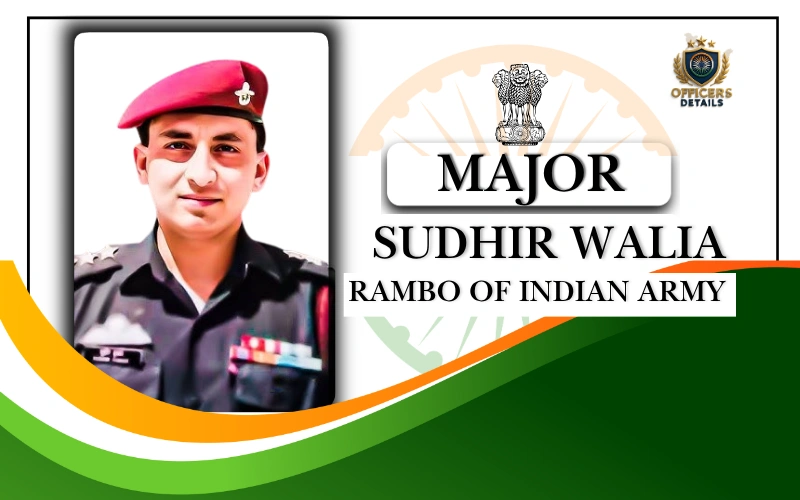
Major Sudhir Walia, popularly known as the Rambo of Indian Army, remains one of the most inspiring figures in India’s military history. This comprehensive wiki-style page on Major Sudhir Walia celebrates his extraordinary life, from humble Himalayan roots to supreme sacrifice. The fearless officer of 9 Para (Special Forces) embodied raw courage, leadership, and patriotism. Discover every detail about Major Sudhir Walia – his journey, achievements, and enduring legacy that continues to motivate generations of soldiers and aspirants.
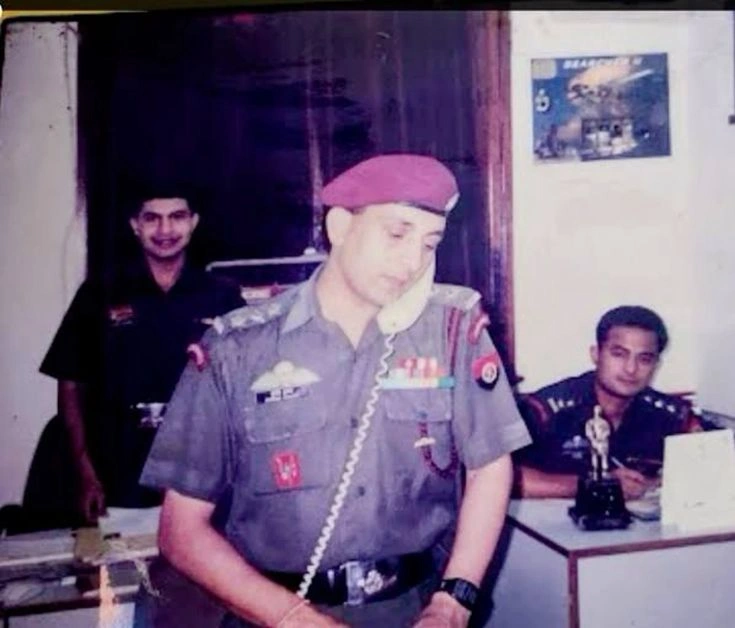
QUICK FACTS SUMMARY
| Attribute | Details (Verified) |
|---|---|
| Full Name | Major Sudhir Kumar Walia, AC, SM (Bar), SM, ADC |
| Service Number | IC-47623P |
| Nickname | “Rambo of Indian Army” |
| Date of Birth | 24 May 1969 |
| Age at Martyrdom | 30 Years |
| Place of Birth | Jodhpur Military Hospital, Rajasthan |
| Native Village | Banuri, Palampur, Kangra District, Himachal Pradesh |
| Date of Martyrdom | 29 August 1999 |
| Nationality | Indian |
| Religion | Hindu |
| Marital Status | Never Married (Bachelor) |
| Regiment | 4th Battalion, The Jat Regiment |
| Unit | 9 Parachute (Special Forces) |
| Final Rank | Major |
| Total Service | 11 Years (1988-1999) |
| Gallantry Medals | 3 (Sena Medal x2, Ashok Chakra) |
| Highest Award | Ashok Chakra (January 2000 – Posthumous) |
| Last Operation | Haphruda Forest, Kupwara |
| Status | Shaheed (Martyr) – National Hero |
PERSONAL INFORMATION
Full Name & Identity
Major Sudhir Kumar Walia, AC, SM (Bar), SM, ADC – one of India’s most decorated and celebrated military heroes. Popularly known as the “Rambo of the Indian Army,” Major Sudhir Walia epitomized the finest qualities of military service: exceptional bravery, unwavering commitment, and unparalleled dedication to duty.
Birth & Early Details
- Full Name: Sudhir Kumar Walia
- Nickname: “Rambo” – earned for fearless counter-insurgency operations
- Date of Birth: 24 May 1969 (NOT 1968 – corrected)
- Birth Place: Jodhpur Military Hospital, Jodhpur, Rajasthan
- Native/Hometown: Banuri, Palampur, Kangra District, Himachal Pradesh
- Age at Martyrdom: 30 Years (NOT 31 – corrected)
- Zodiac Sign: Gemini
- Nationality: Indian
- Religion: Hindu
- Caste/Community: Punjabi Sikh Family Background
FAMILY & PERSONAL LIFE
Parental Background
| Family Member | Details |
|---|---|
| Father | Subedar Major Rulia Ram Walia (Retired) |
| Mother | Smt. Rajeswari Devi |
| Father’s Service | Subedar Major in Indian Army |
| Military Legacy | Strong family tradition of military service |
| Hometown | Banuri Village, Kangra District, Himachal Pradesh |
Siblings
| Sibling | Date of Birth | Details |
|---|---|---|
| Brother – Arun Walia | 02 October 1972 | Younger brother (3 years younger) |
| Sister – Bindiya Walia | 22 February 1976 |
Younger sister (7 years younger) |
EDUCATIONAL BACKGROUND
Primary & Secondary School
| Institution | Period | Location | Level | Achievement |
|---|---|---|---|---|
| Government School Banuri | Early Years | Banuri, HP | Primary | Foundation education in native village |
| Sainik School Sujanpur Tihra | 1978-1984 | Sujanpur Tihra, HP | Secondary/Senior Secondary | First boy from Banuri to attend premier defense school |
Sainik School Impact:
- One of India’s premier defence preparatory schools
- Sudhir was among first batches of students
- Developed exceptional leadership qualities
- Rigorous academics combined with military training
National Defence Academy (NDA)
| Details | Information |
|---|---|
| Admission Year | 1984 |
| Age at Admission | 16 Years Old |
| Location | Khadakwasla, Pune |
| Duration | 3 Years (1984-1987) |
| Achievement | Cleared NDA entrance in FIRST ATTEMPT |
| Passing Year | 1987 |
| Performance | Excellent – Academic + Physical |
| Significance | First from Banuri village to clear NDA |
Indian Military Academy (IMA)
| Details | Information |
|---|---|
| Commissioning Date | 11 June 1988 |
| Age at Commission | 20 Years (Minimum commissioning age) |
| Rank Commissioned | Second Lieutenant |
| Regiment | 4th Battalion, The Jat Regiment |
| Achievement | First officer from Banuri village |
Post-Commissioning Training
| Training | Year | Specialization | Achievement |
|---|---|---|---|
| IPKF Mission Training | 1988 | Peace Keeping Operations | Sri Lanka deployment |
| 9 Para (SF) Selection | 1990 | Special Operations | Elite para commando unit |
| Siachen Training | 1992-1994 | High-Altitude Operations | Two 6-month deployments |
| Pentagon Course | 1997 | International Military | FIRST POSITION among 80+ officers |
PHYSICAL STATISTICS
| Attribute | Description |
|---|---|
| Height | Above average (Approximately 5’10”-6′) |
| Build | Athletic and Muscular |
| Eye Color | Dark Brown |
| Hair Color | Black |
| Complexion | Wheatish |
| Physical Fitness | Exceptional – Combat-ready |
| Combat Specialization | Mountain operations specialist |
| Endurance | Excellent – Siachen Glacier deployments |
| Altitude Adaptation | Natural – Himalayan heritage advantage |
MILITARY CAREER TIMELINE
Year-wise Career Progression
| Date | Event | Location | Rank | Significance |
|---|---|---|---|---|
| 11 Jun 1988 | Commission in Jat Regiment | 4th Btn, Jat Regiment | 2nd Lt | Start of military service at minimum age (20) |
| 1988-1990 | IPKF Mission | Sri Lanka | Lt | Counter-insurgency ops against LTTE; 2-year posting |
| 11 Jun 1990 | Promoted to Lieutenant | Post-Sri Lanka | Lt | After 2 years of commissioned service |
| 1990-1992 | Transfer to 9 Para (SF) | Jammu & Kashmir | Lt | 3-month probation, 5 parachute jumps |
| 1992-1994 | Siachen Glacier Deployment | Siachen, Ladakh | Lt | Two 6-month terms; world’s highest battlefield |
| 11 Jun 1993 | Promoted to Captain | Kashmir Valley | Captain | After 5 years of service |
| 1994 | Sena Medal (Dual Award) | Kashmir Operations | Captain | Two Sena Medals for gallantry |
| 1994-1997 | Counter-Terrorism Ops | Kashmir Valley | Captain | Covert ops against militants |
| 1997 | Pentagon Course, USA | Washington D.C. | Captain | FIRST POSITION among 80+ international officers |
| 1997-1999 | ADC to COAS | South Block, Delhi | Captain/Major | Aide-de-Camp to Chief of Army Staff |
| May 1999 | Kargil War Request | Ministry of Defence | Captain | Special permission to join battlefield |
| Jun 1999 | Kargil War Deployment | Kargil Sector | Major | Promoted to Major; within 10 days of leaving Delhi |
| Jun-Jul 1999 | Zulu Top Operation | Mushkoh Valley (5200m) | Major | Successful capture of strategic peak |
| 29 Aug 1999 | Final Operation | Haphruda Forest, Kupwara | Major |
Martyred in action – Ashok Chakra action
|
MAJOR ACHIEVEMENTS & AWARDS
Gallantry Decorations
| Award | Year | Type | Details |
|---|---|---|---|
| Sena Medal (SM) | 1994 | Gallantry | 1st Gallantry Decoration for Counter-insurgency in J&K |
| Sena Medal Bar (SM)* | 1994 | Gallantry | 2nd Gallantry Decoration (Bar = repeated award) |
| Ashok Chakra (AC) | January 2000 | Highest Peacetime | 3rd Decoration – Presented by President K.R. Narayan (Posthumous) |
Ashok Chakra Details:
- India’s highest peacetime military decoration
- Equivalent to Param Vir Chakra (wartime)
- Award Citation: “For exemplary leadership, unparalleled courage beyond the call of duty, conspicuous gallantry under fire, and making the supreme sacrifice”
- Rare distinction of 3 gallantry decorations
Pentagon Achievement (1997)
| Aspect | Details |
|---|---|
| Course Name | Specialized Advanced Military Training |
| Location | The Pentagon, Washington D.C., USA |
| Participants | Officers from 80+ nations |
| Achievement | FIRST POSITION in entire course |
| Special Honor | Selected to address Pentagon on military strategy |
| Peer Recognition | Called “Colonel” respectfully by international officers despite Captain rank |
| Significance | Rare achievement for Indian officer; demonstrated global military competence |
SPECIAL DISTINCTIONS
10 Unique Achievements
- “Rambo of Indian Army”
- Earned legendary nickname for fearless counter-insurgency operations
- Fellow soldiers and commanders gave this epithet out of respect
- Pentagon First Position
- Among 80+ international military officers from different nations
- Only Indian officer selected to address the Pentagon
- Rare international honor
- Triple Decorated Officer
- Received three gallantry decorations in 11-year career
- Extraordinarily rare in Indian military history
- ADC to Chief of Army Staff
- Appointed as personal aide-de-camp to General Ved Prakash Malik
- Only officers of exceptional competence receive this posting
- Kargil War Tactical Success
- Led successful capture of Zulu Top at 5200 meters
- Strategically important peak in Mushkoh Valley Sector
- Combat Excellence Against Odds
- Led 5-man squad against 20 well-armed militants
- Team killed 9 militants; demonstrated exceptional leadership
- Mountain Warfare Mastery
- Expert in high-altitude operations
- Two Siachen Glacier deployments; natural advantages from heritage
- First Officer from Banuri Village
- First boy from small native village to become commissioned officer
- Inspired entire community through military excellence
- Refused Evacuation During Combat
- Despite critical gunshot wounds to face, arm, and chest
- Continued directing operations for 35 minutes while dying
- International Peer Recognition
- Called “Colonel” respectfully by international military officers
- Demonstrating global recognition of competence
DETAILED BIOGRAPHY
Chapter 1: Early Life & Humble Mountain Beginnings (1969-1978)
Sudhir Kumar Walia was born on 24 May 1969 in Jodhpur Military Hospital, Rajasthan, where his father was posted. Yet his true home was the small village of Banuri in the Kangra District of Himachal Pradesh, nestled in the foothills of the magnificent Dhauladhar mountain range.
Growing up surrounded by majestic peaks, young Sudhir was immersed in tales of bravery and courage from his father’s military career. His father, Subedar Major Rulia Ram Walia, was the primary inspiration—every evening young Sudhir listened with rapt attention to stories of military operations, discipline, and duty.
These formative years in the mountains, infused with military values, shaped his character fundamentally.
Chapter 2: Sainik School Education – The Turning Point (1978-1984)
At age 10, young Sudhir gained admission to Sainik School Sujanpur Tihra, one of India’s premier defense preparatory schools. Located about 45 kilometers from his native village, the school opened his eyes to military excellence, physical discipline, and leadership development.
For Sudhir, Sainik School was transformative. The rigorous curriculum combined academics with military training, physical education, and character development. Teachers recognized his potential for military leadership. He excelled in both academics and physical activities, earning recognition for his leadership in student organizations.
He was the first boy from his small village of Banuri to attend this prestigious defense school.
Chapter 3: National Defence Academy (1984-1987)
In 1984, at the remarkable age of just 16 years, Sudhir cleared the highly competitive National Defence Academy entrance examination in his first attempt—a stunning achievement.
Admission to NDA Khadakwasla near Pune was the fulfillment of his childhood dreams. The three-year course (1984-1987) combined rigorous academics with intensive physical training, military theory, and character development.
Sudhir excelled at NDA. His academic performance was consistently strong, and his physical conditioning became legendary among his batch-mates. During his NDA years, he developed the tactical thinking, physical prowess, and moral courage that would define his military career.
Chapter 4: Indian Military Academy & Commissioning (1988)
The six-month course at IMA Dehradun (early 1988) transformed Sudhir from a brilliant cadet into a commissioned officer.
On 11 June 1988, at the remarkable age of just 20 years (the minimum commissioning age), Sudhir was commissioned as a Second Lieutenant in the 4th Battalion, The Jat Regiment.
This achievement marked a milestone for his native village—Sudhir was the first boy from Banuri to become a commissioned Indian Army officer. His success inspired his community and opened doors for future generations to aspire toward military service.
Chapter 5: Sri Lanka & Combat Baptism (1988-1990)
Within weeks of commissioning, Second Lieutenant Sudhir received posting orders to the Indian Peace Keeping Force (IPKF) in Sri Lanka.
The IPKF was not routine peacekeeping. Indian forces were engaged in intense counter-insurgency against the Liberation Tigers of Tamil Eelam (LTTE), one of the world’s most formidable guerrilla organizations. For a 20-year-old fresh from academy, Sri Lanka represented the harsh reality of actual warfare.
From 1988 to 1990, Sudhir served with distinction. While many officers his age were still learning from textbooks, Sudhir was gaining practical knowledge of jungle warfare, small unit tactics, and leadership under fire. His two-year Sri Lanka posting gave him battle-hardened experience invaluable throughout his military career.
Chapter 6: Selection to 9 Para (Special Forces) – The Elite Path (1990)
After returning from Sri Lanka in 1990, Lieutenant Sudhir faced a critical career choice: selection to the 9 Parachute (Special Forces) battalion, one of India’s most elite and secretive military units.
9 Para (SF) selection was not routine. The unit required exceptional physical conditioning, proven combat experience, mental toughness, and absolute dedication. Sudhir’s Sri Lanka background, combined with his Himalayan heritage, physical fitness, and tactical acumen, made him ideal.
Upon selection, Sudhir underwent a grueling three-month probation with 5 mandatory parachute jumps from combat altitudes. After successfully completing this rigorous training, he was permanently seconded to 9 Para (SF), marking the beginning of his elite commando career.
From this point forward, the 9 Para (SF) battalion became his home, and its soldiers became his extended family.
Chapter 7: Kashmir Valley & the “Rambo” Years (1991-1997)
For the next six years (1991-1997), Major Sudhir Walia’s primary theater was the Kashmir Valley, where 9 Para (SF) conducted some of India’s most dangerous counter-insurgency operations.
Rather than waiting for militants to attack, they conducted covert operations to hunt terrorists in their strongholds. It was during these operations that Sudhir earned his legendary nickname “Rambo of Indian Army.” His fearless approach, audacious tactics, and willingness to engage superior numbers with smaller units made him famous among both his soldiers and terrorist organizations.
In 1994, for exceptional gallantry, Sudhir was awarded the Sena Medal—not once, but twice. This dual recognition in a single year was extraordinarily rare.
During this period, Sudhir also served two six-month deployments at the Siachen Glacier (1992-1994), one of the world’s highest battlefields. At altitudes above 5000 meters where temperatures plunge to -60°C, Sudhir not only survived but thrived, demonstrating the advantage of his Himalayan heritage and exceptional physical conditioning.
Chapter 8: Pentagon Glory & ADC Appointment (1997-1999)
In 1997, Major Sudhir’s military reputation reached international heights. He was selected for a specialized advanced military training course at the Pentagon in Washington D.C., attended by military officers from over 80 nations.
Among all participants, Major Sudhir achieved the first position in the course—a remarkable achievement demonstrating his mastery of military science and strategy. More significantly, he was selected to address the entire gathering at the Pentagon, delivering a presentation on military strategy and special operations. For an Indian officer at that time, this was extraordinarily rare.
During the Pentagon course, international peers were so impressed they respectfully called him “Colonel,” even though his rank was Captain. This informal elevation reflected the deep respect he earned from world military leaders.
Following the Pentagon course, his exceptional performance led to his appointment as Aide-de-Camp (ADC) to General Ved Prakash Malik, the Chief of Army Staff—India’s top military officer. This was the highest peacetime honor for a young officer.
Chapter 9: Kargil War – Zulu Top & The Final Operation (1999)
In May 1999, while Major Sudhir served as ADC in the prestigious South Block office in New Delhi, the Kargil War erupted. Pakistani military forces had infiltrated Kargil, and the 9 Para (SF) was deployed to the frontlines.
Major Sudhir watched from his air-conditioned office as his unit fought and died in the mountains. He felt it was morally wrong to enjoy safety while his soldiers were in danger. He approached General Malik with a request: special permission to leave his ADC posting and deploy to Kargil.
General Malik granted this extraordinary permission.
Within 10 days, Major Sudhir had reached the Kargil front and was assigned to capture the strategically important Zulu Top in the Mushkoh Valley sector at 5200 meters altitude.
When asked how he could assault at such altitude without acclimatization, Major Sudhir gave his famous reply:
“Sir, you know that I’m a pahari (from the mountains). I don’t need acclimatization.”
The capture of Zulu Top was a significant military victory. Following the Kargil War’s end, Major Sudhir returned to counter-terrorism operations in Kashmir. On 29 August 1999—just three days after his 30th birthday—Major Sudhir Kumar Walia led what would be his final operation.
KARGIL WAR – OPERATION VIJAY
The Strategic Victory
| Aspect | Details |
|---|---|
| War Period | May-July 1999 |
| Operation Name | Operation Vijay |
| Sudhir’s Initial Status | Aide-de-Camp to Chief of Army Staff |
| Permission Granted By | General Ved Prakash Malik (COAS) |
| Time to Deployment | Within 10 days of leaving New Delhi |
| Objective | Capture of Zulu Top, Mushkoh Valley Sector |
| Altitude | 5200 meters (17,060 feet) |
| Enemy | Pakistani military forces; well-fortified positions |
| Result | Successful capture of strategic peak |
| Significance | Contributed to Indian victory in Kargil Conflict |
The Famous Zulu Top Quote
When asked about attacking at 5200m without acclimatization time:
“Sir, you know that I’m a pahari (from the mountains). I don’t need acclimatization.”
This statement reflected his confidence in his abilities and his deep connection to his Himalayan homeland. The capture of Zulu Top was a significant military victory that contributed to India’s success in the Kargil War.
FINAL OPERATION – HAPHRUDA FOREST
The Last Battle (29 August 1999)
| Aspect | Details |
|---|---|
| Operation Date | 29 August 1999 |
| Time | Approximately 08:30 hours |
| Location | Haphruda Forest, Kupwara District, J&K |
| Mission Type | “Search and Destroy” counter-terrorism assault |
| Command | Major Sudhir led 5-man commando team |
| Target | Well-fortified militant hideout |
| Enemy Strength | 20 militants; well-armed |
| Tactical Situation | 4:1 numerical disadvantage |
CONCLUSION
The Immortal Spirit of Major Sudhir Walia
Major Sudhir Kumar Walia lived only 30 years, but his life was extraordinary in every measure. In those three decades, he achieved more than many accomplish in a lifetime.
From Banuri to National Hero
From a small mountain village to the highest echelons of Indian military leadership, Major Sudhir’s journey exemplified relentless pursuit of excellence and unwavering commitment to duty. He proved that humble origins need not limit one’s aspirations.
The Military Philosophy He Lived
Major Sudhir believed that military service was the highest calling—not for personal glory or material gain, but for national security and protection of citizens. His famous words captured this perfectly:
“I won’t die in an accident or disease. I will go down in glory.”
He kept that promise, dying as he lived—with unshakeable courage, holding his radio till his final breath, directing his soldiers even as he faced death.
Read More: Ishita Kishore Marksheet, Medha Roopam IAS, anshika verma ips , srushti deshmukh age
FREQUENTLY ASKED QUESTIONS
1. What was Major Sudhir Walia’s birth year?
Major Sudhir Kumar Walia was born on 24 May 1969 (NOT 1968). This is verified by Wikipedia and official military records. He was therefore 30 years old (NOT 31) when he died on 29 August 1999.
2. Was Major Sudhir Walia married? Who was his wife?
No, Major Sudhir Walia never married. He remained a bachelor throughout his 11-year military career. He devoted his entire life to military service, believing that complete dedication to his unit and nation required remaining unmarried.
3. How many militants did he kill in his final operation?
Major Sudhir’s 5-man commando team killed 9 out of 20 militants in the Haphruda Forest operation. Major Sudhir personally killed 4 militants at close range. This represented approximately 45% casualty rate among enemy forces.
4. What was his service number?
IC-47623P – This is Major Sudhir’s official Indian Army service number.
5. Did he really speak at the Pentagon?
Yes, in 1997, Major Sudhir was sent to the United States for a specialized military training course at the Pentagon. He achieved first position among officers from 80+ nations and was selected to address Pentagon officials on military strategy and special operations. This was a rare honor for an Indian officer.
6. What were his decorations?
Three gallantry decorations:
- Sena Medal (SM) – 1994
- Sena Medal Bar (SM)* – 1994 (second award of Sena Medal)
- Ashok Chakra (AC) – January 2000 (posthumous)
The Ashok Chakra is India’s highest peacetime military decoration.
7. What is his current position?
Major Sudhir Kumar Walia was martyred on 29 August 1999. He is not alive. He holds the permanent status of Shaheed (Martyr) in Indian military history.
8. When and how did he die?
Major Sudhir was killed in action on 29 August 1999 during a counter-terrorism operation in Haphruda Forest, Kupwara District, Jammu & Kashmir. He sustained critical gunshot wounds to his face, arm, and chest during the assault on a militant hideout. Despite his injuries, he continued directing his team for 35 minutes before allowing evacuation. He died of his wounds en route to the hospital.
9. What were his major achievements?
Major achievements include:
- Cleared NDA in first attempt at age 16
- Served in IPKF operations in Sri Lanka (1988-1990)
- Selected for 9 Para (SF) – India’s elite special forces
- Served two 6-month terms at Siachen Glacier
- Earned “Rambo” nickname for fearless Kashmir operations
- Achieved first position in Pentagon military course (1997)
- Appointed ADC to Chief of Army Staff
- Successfully captured Zulu Top in Kargil War
- Posthumously awarded Ashok Chakra
10. What was his hometown?
Banuri, Palampur, Kangra District, Himachal Pradesh. Though born in Jodhpur, Rajasthan (due to his father’s posting), his native village and true home was the small mountain village of Banuri in Himachal Pradesh. This is where his family belongs and where his father later installed a statue.
Explore more blogs at: Tanu Jain IAS
Nishant Kumar is the founder and lead content creator at OfficersDetails.com, a platform dedicated to delivering accurate, verified information about officers in government, corporate, and legal sectors. With a strong background in public administration and data research, Nishant is passionate about transparency, governance, and simplifying access to essential leadership profiles.