
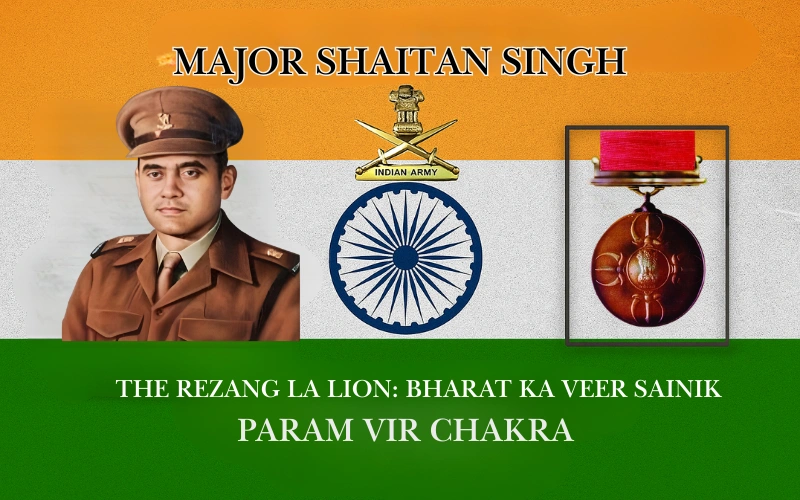
Major Shaitan Singh Bhati stands as one of India’s most celebrated military heroes, a symbol of unparalleled courage and sacrifice. On November 18, 1962, during the Indo-China War, Major Shaitan Singh led 120 soldiers of Charlie Company, 13 Kumaon Regiment, in one of the most heroic last stands in military history at Rezang La in Ladakh. Fighting at an altitude of 16,000 feet in sub-zero temperatures against overwhelming Chinese forces, Major Shaitan Singh and his men fought till their last breath, with 114 soldiers making the supreme sacrifice. For his extraordinary valor, Major Shaitan Singh was posthumously awarded the Param Vir Chakra, India’s highest military decoration.
Personal Information: Major Shaitan Singh
| Attribute | Details |
|---|---|
| Full Name | Major Shaitan Singh Bhati |
| Nickname | The Lion of Rezang La |
| Date of Birth | December 1, 1924 |
| Date of Death | November 18, 1962 (Age 37 years) |
| Birth Place | Bana Village, Jodhpur District, Rajasthan, India |
| Nationality | Indian |
| Zodiac Sign | Sagittarius |
| Religion | Hinduism |
| Caste/Community | Rajput (Bhati Clan) |
| Regiment | 13 Kumaon Regiment, Indian Army |
| Rank | Major |
| Unit | Charlie Company, 13 Kumaon |
| Service Number | IC-7990 |
| Years of Service | 1949-1962 (13 years) |
Family & Personal Life: Major Shaitan Singh Bhati
| Aspect | Details |
|---|---|
| Father’s Name | Hem Singh Bhati |
| Mother’s Name | Not widely documented |
| Spouse/Wife | Smt. Prem Kanwar |
| Children | Two daughters and one son |
| Son’s Name | Virendra Singh Bhati |
| Daughters’ Names | Not publicly documented |
| Hometown | Bana Village, Jodhpur, Rajasthan |
| Marital Status | Married (at the time of martyrdom) |
| Community Background | Royal Rajput family of Jodhpur |
| Family Tradition | Military service and valor |
Major Shaitan Singh came from a distinguished Rajput family with a strong tradition of military service. His wife, Prem Kanwar, displayed immense courage after his martyrdom, raising their three children with the values of patriotism and sacrifice that Major Shaitan Singh embodied.
Educational Background: Major Shaitan Singh
Major Shaitan Singh Bhati received his education in Rajasthan before joining military service. While detailed records of his early education are limited, his educational journey reflects the traditional Rajput upbringing combined with modern military training.
| Educational Stage | Institution/Details |
|---|---|
| Primary Education | Local schools in Jodhpur, Rajasthan |
| Secondary Education | Government school in Jodhpur region |
| Military Training | Indian Military Academy (IMA), Dehradun |
| Commission Year | 1949 |
| Type of Commission | Emergency Commissioned Officer |
| Military Courses | Advanced infantry tactics, mountain warfare training |
| Special Training | High-altitude warfare, leadership courses |
Major Shaitan Singh joined the Indian Army as an Emergency Commissioned Officer in 1949, during the post-independence period when India was rapidly building its defense forces.
Physical Statistics: Major Shaitan Singh
| Attribute | Details |
|---|---|
| Height | Approximately 5’9″ (175 cm) |
| Build | Athletic and robust |
| Eye Color | Dark Brown |
| Hair Color | Black |
| Distinctive Features | Military bearing, commanding presence |
| Physical Fitness | Exceptionally fit for high-altitude warfare |
Major Shaitan Singh maintained exceptional physical fitness, which proved crucial during the Battle of Rezang La where soldiers fought in extreme conditions at 16,000 feet altitude with temperatures dropping to -20°C.
Military Career Timeline: Major Shaitan Singh Bhati
| Year | Rank/Position | Posting/Achievement |
|---|---|---|
| 1949 | Second Lieutenant | Commissioned into the Indian Army (13 Kumaon Regiment) |
| 1950-1954 | Lieutenant | Various postings across India, developed expertise in infantry operations |
| 1955-1958 | Captain | Promoted to Captain, served in challenging terrains |
| 1959-1961 | Captain | Operational duties in border areas |
| 1962 (Early) | Major | Promoted to Major, given command of Charlie Company |
| October 1962 | Major (Company Commander) | Deployed to Rezang La, Ladakh during Indo-China conflict |
| November 18, 1962 | Major (Martyrdom) | Led the historic Battle of Rezang La, fought till last breath |
The Battle of Rezang La: Major Shaitan Singh’s Finest Hour
| Category | Details |
|---|---|
| Battle Name | Battle of Rezang La |
| Date | November 18, 1962 |
| Location | Rezang La, Ladakh, India |
| Indian Commander | Major Shaitan Singh Bhati |
| Indian Unit | Charlie Company, 13 Kumaon Regiment |
| Indian Strength | 120 soldiers |
| Enemy (Chinese) Strength | 3,000–5,000 soldiers |
| Altitude | 16,000 feet (4,877 meters) |
| Temperature | -20°C to -30°C |
| Terrain | Rocky, frozen mountainside |
| Battle Summary | Major Shaitan Singh and his company faced overwhelming odds; refused to retreat despite heavy injuries, directing his men until death. |
| Indian Casualties | 114 soldiers martyred (including Major Shaitan Singh) |
| Survivors | 6 soldiers (5 captured as POWs) |
| Chinese Casualties | Estimated 1,300–1,400 killed or wounded |
| Result | Moral victory for India; demonstrated exceptional bravery and fighting spirit despite military withdrawal |
Major Achievements & Recognition: Major Shaitan Singh
| Year | Award/Honor | Description |
|---|---|---|
| 1962 (Posthumous) | Param Vir Chakra | India’s highest military decoration for conspicuous gallantry |
| 1997 | Rezang La Memorial | Memorial built at battle site honoring Major Shaitan Singh and his men |
| 2021 | Shaitan Singh Nagar | Area in Rajasthan named after him |
| Various | Military Citations | Mentioned in numerous military history books and documentaries |
| Ongoing | National Recognition | Regularly honored on Rezang La Day (November 18) |
Param Vir Chakra Citation
| Field | Details |
|---|
| Recipient | Major Shaitan Singh |
| Award | Param Vir Chakra |
| Date of Action | 18 November 1962 |
| Location | Rezang La, Chushul sector, Ladakh, India |
| Height | About 17,000 feet |
| Unit | Infantry Battalion (Company Command) |
| Enemy | Chinese forces |
| Situation | Company position subjected to heavy artillery, mortar, and small arms fire; attacked in overwhelming strength in successive waves |
| Actions | – Dominated scene of operations – Moved between platoon posts at great personal risk – Continued to lead despite serious wounds – Inspired troops to fight gallantly and inflict heavy casualties on the enemy |
| Casualties & Impact | – Heavy casualties on Indian side – Enemy losses four to five times that of Indian troops |
| Final Act | Ordered his men to leave him to save their lives after being severely wounded |
| Legacy / Commendation | Parents, wife, and family have reason to be proud; exemplified courage and leadership in keeping with the highest traditions of the Indian Army |
Financial Information: Major Shaitan Singh
At the time of his martyrdom in 1962, Major Shaitan Singh would have been receiving military salary commensurate with his rank. While specific financial details from that era are not extensively documented, we can provide context:
| Aspect | Details |
|---|---|
| Military Salary (1962) | Approximately ₹500-800 per month (Major’s salary in 1962) |
| Family Pension | Government of India provided family pension and support |
| Param Vir Chakra Benefits | Monetary award and lifetime benefits for family |
| Current Family Support | Government continues to honor and support martyrs’ families |
| Net Worth (Historical) | Focused on service, not material wealth |
| Financial Philosophy | “Duty, honor, country above all else” |
Detailed Biography: The Life Journey of Major Shaitan Singh Bhati
Early Life and Humble Beginnings (1924-1942)
Major Shaitan Singh Bhati was born on December 1, 1924, in Bana village of Jodhpur district in Rajasthan. He came from a Rajput family with a strong tradition of military service and valor. The Bhati Rajputs have a centuries-old history of defending their land and honor, and young Shaitan Singh grew up hearing tales of ancestral bravery.
Growing up in rural Rajasthan, Major Shaitan Singh experienced the hardships of village life while being instilled with values of courage, honor, and duty. His father, Hem Singh Bhati, ensured that Shaitan Singh received education while maintaining strong cultural and martial traditions.
Military Calling and Training (1942-1949)
The period of World War II and India’s independence struggle deeply influenced young Shaitan Singh. Inspired by the stories of Indian soldiers fighting in various theaters of war, he decided to join the Indian Army. In 1949, shortly after India’s independence, Major Shaitan Singh was commissioned as an Emergency Commissioned Officer into the 13 Kumaon Regiment.
His training at the Indian Military Academy in Dehradun shaped him into a professional officer. The rigorous training in infantry tactics, leadership, and military strategy prepared him for the challenges ahead. Major Shaitan Singh distinguished himself during training with his physical fitness, tactical acumen, and natural leadership abilities.
Building a Military Career (1949-1961)
Over the next decade, Major Shaitan Singh Bhati served in various capacities across India, steadily rising through the ranks. He was promoted to Lieutenant, then Captain, demonstrating exceptional competence in infantry operations. His postings took him to different terrains and operational environments, providing him with diverse military experience.
During these years, Major Shaitan Singh also built his family life. He married Prem Kanwar and became father to three children—two daughters and a son. Despite the demanding nature of military service, he maintained close family ties and instilled in his children the same values of duty and honor that guided his life.
The Road to Rezang La (1962)
In early 1962, Major Shaitan Singh was promoted to the rank of Major and given command of Charlie Company of the 13 Kumaon Regiment. This company consisted primarily of Ahir soldiers, known for their martial tradition and loyalty. Major Shaitan Singh quickly established a strong bond with his men, earning their respect through his fair leadership and genuine concern for their welfare.
As tensions escalated between India and China over the border dispute, Major Shaitan Singh’s company was deployed to the Ladakh sector in October 1962. They were assigned to defend Rezang La, a strategic pass at an altitude of approximately 16,000 feet (some sources cite 17,000 feet) in the Chushul sector.
The Historic Battle: November 18, 1962
The morning of November 18, 1962, began like any other cold day at Rezang La, with temperatures hovering around -20°C to -30°C. Major Shaitan Singh Bhati and his 120 soldiers maintained their defensive positions across five platoon posts, knowing that Chinese forces were in the area.
At approximately 5:00 AM, the Chinese forces launched their attack with heavy artillery, mortar, and machine gun fire. The initial bombardment was followed by waves of infantry attacks involving thousands of Chinese soldiers. The sheer numerical superiority of the enemy was overwhelming—estimates suggest the Chinese forces numbered between 3,000 to 5,000 troops against Major Shaitan Singh’s 120 men.
Despite the odds, Major Shaitan Singh Bhati organized a fierce defense. He personally moved from one platoon position to another under heavy enemy fire, encouraging his men and directing the defense. His presence inspired his soldiers to fight with extraordinary courage. Each platoon post became a fortress of resistance.
As the battle raged, Major Shaitan Singh was wounded by enemy fire, sustaining injuries to his arms and abdomen. Despite his wounds, he refused to be evacuated and continued to command his men. His soldiers, following their commander’s example, fought with unmatched ferocity. When ammunition ran low, they engaged in hand-to-hand combat with the enemy.
The fighting continued for several hours. Major Shaitan Singh’s men inflicted devastating casualties on the Chinese forces, with estimates suggesting over 1,300 enemy soldiers were killed or wounded. However, the overwhelming numerical superiority eventually took its toll. One by one, the brave soldiers of Charlie Company fell, fighting till their last breath.
Major Shaitan Singh, critically wounded and unable to move, ordered his remaining men to save themselves and withdraw. True to his character, he put his soldiers’ lives above his own even in his final moments. Most of his men refused to leave their commander and continued fighting until they too were killed.
The Ultimate Sacrifice
Major Shaitan Singh Bhati breathed his last on the frozen battlefield of Rezang La, having fought one of the most heroic defensive battles in military history. Of the 120 soldiers under his command, 114 made the supreme sacrifice. Only six soldiers survived—five were taken as prisoners of war by Chinese forces and later released, while one soldier who had been sent on patrol was the only immediate survivor.
The battlefield presented a haunting scene when Indian forces later recaptured the area. Soldiers were found in their defensive positions, many frozen in firing poses, surrounded by empty ammunition boxes and enemy bodies. The determination of Major Shaitan Singh and his men was evident in every inch of the battlefield.
Recognition and Legacy
For his extraordinary courage, leadership, and sacrifice, Major Shaitan Singh Bhati was posthumously awarded the Param Vir Chakra, India’s highest military decoration. The citation specifically mentioned his leadership under fire, his refusal to be evacuated despite wounds, and his inspiring example that motivated his men to fight to the last.
Major Shaitan Singh’s wife, Prem Kanwar, received the Param Vir Chakra on his behalf in a solemn ceremony. She raised their three children with the same values of courage and patriotism that Major Shaitan Singh embodied. His son, Virendra Singh Bhati, has kept his father’s legacy alive through various public engagements and by sharing his father’s story with new generations.
Conclusion:
Major Shaitan Singh Bhati life and sacrifice represent the highest ideals of military service—courage, duty, honor, and selfless sacrifice. His last stand at Rezang La on November 18, 1962, will forever remain etched in the annals of Indian military history as one of the most heroic defensive battles ever fought.
The Battle of Rezang La was not just a military engagement; it was a testament to the indomitable spirit of Indian soldiers and the quality of leadership that inspires ordinary men to achieve extraordinary feats. Major Shaitan Singh transformed 120 soldiers into an immortal company that inflicted devastating casualties on a force twenty-five times larger, fighting in one of the most inhospitable environments on Earth.
Read More : anshika verma ips , kanishak kataria , shakti dubey age
Frequently Asked Questions
1. Who was Major Shaitan Singh Bhati?
Major Shaitan Singh Bhati was an Indian Army officer who was posthumously awarded the Param Vir Chakra for his extraordinary courage during the Battle of Rezang La on November 18, 1962, during the Indo-China War. He commanded Charlie Company of the 13 Kumaon Regiment.
2. When did Major Shaitan Singh die?
Major Shaitan Singh died on November 18, 1962, during the Battle of Rezang La in Ladakh, while defending Indian territory against Chinese forces during the Indo-China War.
3. What is Major Shaitan Singh famous for?
Major Shaitan Singh is famous for leading one of the most heroic last stands in military history at Rezang La, where his company of 120 soldiers fought against approximately 3,000-5,000 Chinese troops, inflicting heavy casualties despite being vastly outnumbered.
4. Was Major Shaitan Singh married? Did he have children?
Yes, Major Shaitan Singh was married to Smt. Prem Kanwar and had three children—two daughters and one son named Virendra Singh Bhati.
5. What awards did Major Shaitan Singh receive?
Major Shaitan Singh was posthumously awarded the Param Vir Chakra, India’s highest military decoration for conspicuous gallantry in the presence of the enemy.
6. Where is the Rezang La Memorial located?
The Rezang La Memorial is located at the battle site in Ladakh, at an altitude of approximately 16,000 feet. It honors Major Shaitan Singh and the 114 soldiers who sacrificed their lives in the battle.
7. What is Shaitan Singh Nagar?
Shaitan Singh Nagar refers to areas and localities named in honor of Major Shaitan Singh, primarily in Rajasthan, to commemorate his sacrifice and service to the nation.
8. Are there any movies about Major Shaitan Singh?
While there isn’t a major Bollywood film exclusively about Major Shaitan Singh, the Battle of Rezang La and his heroism have been featured in documentaries, military history programs, and short films. His story has been referenced in various media discussing the 1962 Indo-China War.
9. What was Major Shaitan Singh’s rank?
Major Shaitan Singh held the rank of Major in the Indian Army at the time of his martyrdom. He was commissioned as an Emergency Commissioned Officer in 1949 and rose through the ranks to become a Major by 1962.
10. How many soldiers survived the Battle of Rezang La?
Out of 120 soldiers, only 6 survived the Battle of Rezang La. Of these, 5 were taken as prisoners of war by Chinese forces and later released, while 1 soldier who had been sent on patrol survived the battle.
Read More: Artika Shukla
Explore more blogs at: A Brand Owner
Nishant Kumar is the founder and lead content creator at OfficersDetails.com, a platform dedicated to delivering accurate, verified information about officers in government, corporate, and legal sectors. With a strong background in public administration and data research, Nishant is passionate about transparency, governance, and simplifying access to essential leadership profiles.